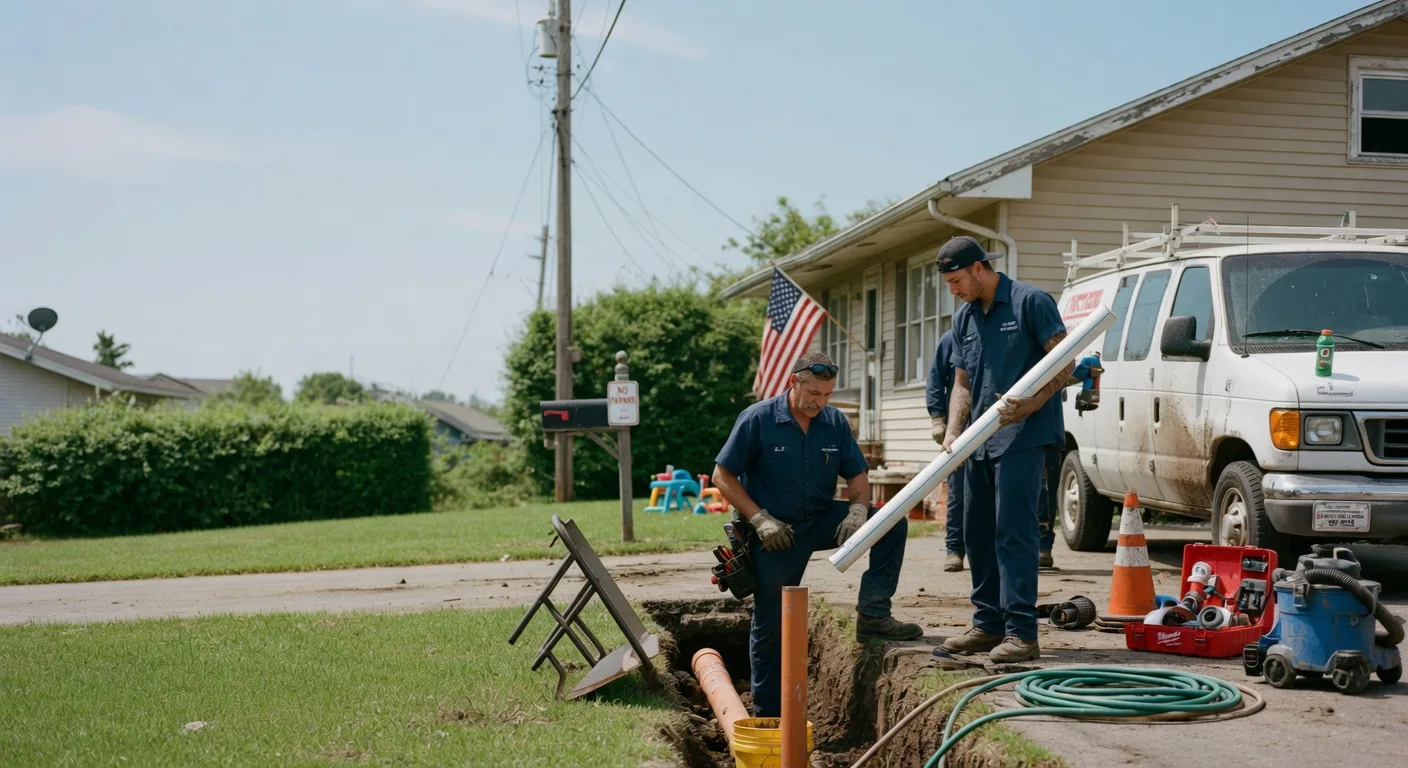
Why does the same drain keep clogging again just days after it was cleared?
A clog that returns within days almost always means one of two things. Either the first cleaning opened a path without removing the whole blockage, or the real cause was never touched. A cable machine punches a channel through the middle of a clog. That restores flow, but it can leave a ring of grease, scale, or packed debris clinging to the pipe wall, and that ring catches the next load of waste quickly. Underneath that sit the causes a cable cannot fix: roots growing in at a clay joint, a bellied section holding standing water, a cracked or offset joint catching paper, or rough scale in cast iron. Start by noting whether it is one fixture or several. A single kitchen or bathroom line that refills fast often needs hydro jetting, which scours the full width of the pipe wall rather than opening a hole through the center. A repeat clog in the main, or several fixtures slowing together, needs a camera inspection, because it shows the pipe's condition instead of just clearing it again. Chemical cleaner between visits usually makes things worse for the next tool. Expert Plumbers Co connects homeowners in Jewell, KS with an independent local plumber who can find out why the drain will not stay clear. Access to the line and how much of it must be opened up are what shape the repair.
Clearing a drain is not the end of the story, and knowing what to do afterward keeps the clog from coming back. Once a line is cleared, run hot water for a minute, then fill the sink and let it drain to check the flow. Use a drain strainer in showers and kitchen sinks to catch hair and food scraps before they enter the pipe. Keep a note of the date and what the plumber found, because a second clog in the same place within a few months is useful information. If hair is the cause, a monthly manual clean of the strainer and stopper helps more than any product. If the plumber mentions roots, a bellied pipe, or a cracked joint, ask what the options are and how quickly the problem is likely to return. Older homes often have cast iron or clay lines, where recurring trouble is more common than in newer plastic pipe.
What does grease actually do to a drain pipe?
Grease leaves the sink as a liquid, and the pipe is where it stops being one. Warm fat cools on contact with the cold pipe wall and hardens into a waxy layer. That layer is slightly sticky, so it grabs coffee grounds, food scraps, and lint, and each meal adds another coat. Over weeks the opening shrinks like an artery, and water that used to flow freely starts to drain slowly and gurgle. Hot water does not fix this; it only carries the grease farther down the line, where it cools and sets again, sometimes in the main. That is why a kitchen sink that slows while every other fixture drains normally is nearly always grease in the branch line close to the trap. A cable machine cuts a channel through the buildup and often restores flow, but the coating stays on the pipe wall and narrows again within weeks. Hydro jetting sends high-pressure water around the whole interior and strips the grease off the pipe wall, which is why it is the usual answer for repeat kitchen clogs. Wiping pans with a paper towel and putting fat in the trash prevents most of it. Expert Plumbers Co connects homeowners with an independent local plumber who can tell whether a cable or a jetter fits the line. Access and the amount of buildup affect the job.
The place where most people go wrong is the hot water habit. Running hot water for a few seconds after washing dishes does not carry grease to the sewer, it only moves it down the line a few feet, where it cools and sets. A much better routine is to scrape plates into the trash, wipe greasy pans with a paper towel, and keep a jar for cooking oil that can go in the garbage once it is full. Dish soap makes grease look like it has dissolved, but it only breaks it into smaller droplets that still stick further along. Garbage disposals do not solve this either, since they chop food without removing the fat. In restaurants and busy households, a grease trap or interceptor may be present, and it needs regular emptying. If the sink has slowed repeatedly, mention that to the plumber, since a pattern points to a coating that needs scouring rather than another quick clear.
What is a cleanout and why does the plumber keep asking if I have one?
A cleanout is a capped pipe fitting that gives a plumber direct access to the sewer line. It usually looks like a round plug, three or four inches across, sitting on a short stub of pipe. You will often find one in the basement near the main stack, in a crawlspace, along an outside wall or in the yard near the foundation.
The plumber asks because it decides how the job is done. With a cleanout, a cable machine or hydro jetter goes straight into the line. Without one, the equipment has to go in through a toilet, a floor drain or the roof vent. That can mean pulling a toilet, and it limits how far the machine travels and how well a camera can see.
Safe homeowner check: find the cap and note where it is. Do not unscrew it if the house drains are backed up. Water can be standing behind the cap, and it will come out.
Stop running water and call now if the cleanout is wet or leaking, or if several drains in the house are backing up together. That points to a blockage in the main line.
If your home has no cleanout, adding one is often part of the job. What it costs depends on access, how deep the line is, how much has to be dug or cut open, and whether a permit applies.
Expert Plumbers Co is a referral service. Call (380) 262-9173 and we will connect you with a plumber serving Jewell, KS for Drain Cleaning.
A few practical points help when a cleanout is involved. The cap can be stuck from years of rust or paint, and forcing it with a long wrench can crack the fitting, so leave a stubborn one to the plumber. Keep the area around it clear of storage, snow, soil or landscaping so the crew can reach it quickly. In older homes the cleanout may have been buried when the yard was regraded, or covered by a patio or flooring, and finding it can take some probing. Newer homes usually have one near the foundation or at the property line, sometimes with a green or black cap flush with the lawn. If a plumber can find or install one, later cleanings and camera inspections become simpler and less disruptive, because the equipment enters the line at a planned point and nothing indoors has to be disturbed or removed.
What is trenchless sewer repair and when is it an option?
You have been told the sewer line may need replacing, and you want to know if that means digging it all up. Trenchless repair avoids that. The plumber works from one or two small access pits, or from an existing cleanout, and either lines the old pipe from the inside or pulls a new pipe through the old path.
It is an option when the line is cracked, offset at a joint, or split by root intrusion at a clay joint, but still runs as one continuous pipe. Cast iron choked with scale can sometimes be lined too, after the scale is cleared. That usually means hydro jetting first, then a camera inspection to confirm the pipe condition.
It is not an option when the pipe has collapsed, when a bellied line holds water and the slope has to be corrected, or when sections are crushed or missing. A liner follows the old path, so a sag stays a sag. Those jobs need open excavation.
The camera inspection decides it. If the main line clogs again after every Drain Cleaning visit, the pipe may be failing, not just dirty.
Cost depends on how deep and how long the line is, how many access points are needed, the materials used, how much has to be opened up or removed above it, and any permit or code requirement. Expert Plumbers Co is a referral service, not a plumbing contractor. Call (380) 262-9173 and we will refer you to a plumber serving Jewell, KS who can inspect the line.
Before any lining starts, ask the plumber to confirm where every side connection joins the main. Branches such as a second bathroom or a laundry line have to be reopened from the inside once the liner sets, and the camera run afterwards should show each one open. Tell the plumber about earlier backups, the age of the house and any past repairs, because older homes often have clay, cast iron and fiber pipe in the same run, and the liner has to bond to each. The finished pipe is slightly narrower inside, but its surface is smooth, so flow usually improves. Plan around laundry and showers while the liner cures, since the line cannot be used until it has set. Ask for the recording of the finished pipe and keep it with your house papers. It helps if you sell the home, and it shows the next plumber exactly what was installed and where it runs.
Small flies keep coming out of the drain. Is that a clog?
Possibly, but not always. Small flies rising out of a drain are drain flies. They breed in the organic film that coats the inside of the trap and the first few inches of pipe, not in clean standing water. The film is the nursery.
A slow or partly blocked drain gives that film somewhere to sit, which is why flies and a slow drain often show up together. A drain nobody uses is a different case. When its trap dries out, flies and sewer odor both come straight up the pipe.
Safe homeowner check. Tape a card or a clear bag over each suspect drain overnight. Flies on the underside show which one they come from. Clean the strainer and the visible part of the drain. On a rarely used drain, pour in a bucket of water to refill the trap.
A cable machine is enough when one fixture is slow and no flies are involved. A cable only cuts a channel through the blockage and leaves the film on the pipe wall. A line that keeps producing flies after cleaning usually needs hydro jetting, which strips the wall back to bare pipe.
One fixture is a local job. Flies plus several slow drains point further down the line: grease build-up on the pipe wall, a bellied section holding water, or root intrusion at a joint. That calls for a camera inspection before anyone picks equipment.
Stop running water and call if drains gurgle, sewage odor fills the room, or water rises in the lowest fixture.
Expert Plumbers Co is a referral service. We refer homeowners in Jewell, KS to an independent local plumber for Drain Cleaning. Call (380) 262-9173.
The choice of cleaner matters. Bleach poured down the drain kills flies on contact but leaves the film they feed on, so they return within days. Boiling water helps on metal pipe but can soften or loosen joints on some plastic, so use hot tap water. A stiff brush on the strainer area and the first few inches of pipe does more than any liquid. An enzyme cleaner left overnight can digest the film, but treat it as upkeep, not a cure for a blocked line.
Check the overflow opening on sinks and tubs too. That channel is rarely cleaned and can breed flies.
Adult drain flies are weak fliers and rest on walls near the source, so counting them each evening shows whether cleaning is working. If the numbers do not fall within a week of thorough cleaning, the source is deeper in the line, or in a seldom-used floor drain in a basement or utility room that nobody thinks about.